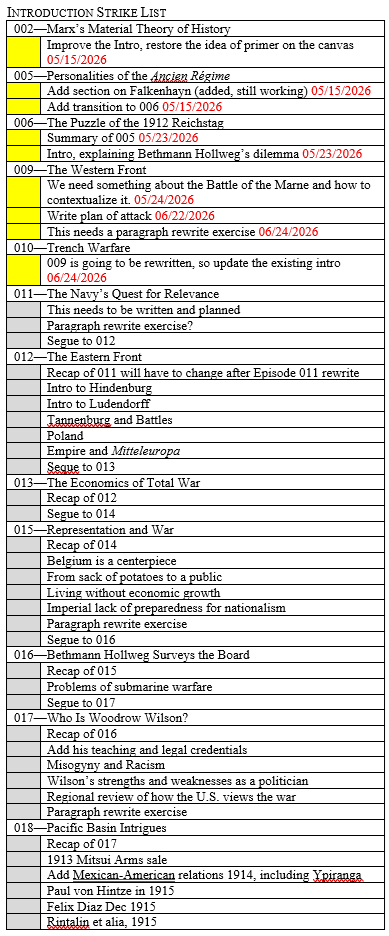

Okay, I’m hitting a point where I have to do some new writing. Episode 11 on the Navy will need substantial new writing, as it is becoming its own episode. I’ve pasted a bunch of text excerpts from several books into the notes and, with chronological organization of the material and fresh writing. This should bolster the text enough to stand on its own successfully. There is, however, prior text to begin with.
Episode 12 on the Eastern Front is completely new writing, which is more daunting. It feels to me that in most lead-ups to the Weimar Republic, the Eastern Front is taken as a sideshow that one might omit. Indeed, the consistency of this choice is why I find myself writing this episode from scratch so late in this process. Most of the sources, selected as they were to lead up to German Revolution, skirted around it. I’ve had to go to other sources to reconstruct it.
This defect in this thematic coverage seems so unusual to me. Yes, these spectacular conquests were swept away by the Armistice and that can make them seem as if they were a sideshow. The Germans held and kept this territory for such a short time. Moreover, the territories themselves don’t come back into the story of the Weimar Republic. With desire to “jump right in” to the story of the Weimar Republic, I can see why this history gets glossed over.
The problem is that Germans didn’t see the Eastern Front as a sideshow, but as an extension of empire that was the main proof of their prowess in the war. The Eastern Front is the site of most of the evidence that supports the idea that Germans should have won. I don’t know how we understand the Dolchstoßlegende without it. I don’t know how we understand Hindenburg without it. Without Tannenberg and the conquests of the Eastern Front, Hindenburg could have never become a national symbol who could be elected the presidency of the Reich. No, the Eastern Front is where all this mythology was made and the mythology is central to Weimar history. We can’t skip it. It’s too important.