

I was having a lot of trouble figuring out where submarine warfare should go. Germany has approached the war from a classic 18th century formulation. It mocks the solemnities of the so-called “international law” and, on the surface, takes a realist approach. March through Belgium and seize Northern France. The Germans didn’t nab Paris, but the French barely take back a sliver of Alsace-Lorraine and barely save Paris by ferrying soldiers to the front in taxi cabs. And the French will look awful until 1918. The British will fare little better on the Western Front. This does seem like fairly sane strategy.
But then we get all this whining about Belgium. I’ve had the worst trouble understanding why anyone cared. I mean, since when is anyone moved by a princess in a white flowing gown saying, “We are a small planet! We have no weapons!” Indeed, strangely enough, Lucas’s royal ladies are all proficient with a blaster. They practice personal protection through weapons. Why do their planets have none?
Growing up as an Arab-American who was trying to become a comparative political scientist of the Middle East, the two cases that jump out at me are Iraq and Kuwait in 1991 as opposed to Syria and Lebanon in 1990. It seems to me that Syria was allowed to absorb Lebanon but Iraq was repulsed from occupying Kuwait for two reasons. The lesser reason was because Syria refrained from occupying Lebanon in name, despite the fact that Hafiz al-Asad was the de facto sovereign of Lebanon, whereas Saddam Hussein insisted on open annexation. The far greater reason is that Lebanon in no way constitutes a significant interest of the United States whereas Iraq’s bid to occupy Kuwait would give Saddam Hussein control of a spare capacity of 4.8 million to 5 million barrels per day, rivaling Saudi Arabia. The United States would not tolerate that much oil in the hands on a non-client, especially given that Iran, ranked just after Saudi produced 2.9 to 3.1 million. The independence of Kuwait was an interest of the United States and independence of Lebanon was not. Realism explains it all. The princess in the flowing white gown can reread the Melian Dialogue.
Yet, human interest seems to play a role in the Belgium story. The Germans are considered bad guys for that move and that seems to affect world opinion, so much so that Britain’s own brazen violation of international law in its attempt to starve German civilians is of utterly no consequence internationally. These two things are not considered equal at all. I have a lot of trouble understanding that.
Indeed, submarine warfare, a logical way to strike back at the blockade is a question intimately tied to Germany’s reputation abroad. They somehow become greater villains. Realism does not explain this very well. That said, liberalism’s insistence of human rights and international law has nothing to tell us about the Middle East. Why the difference?
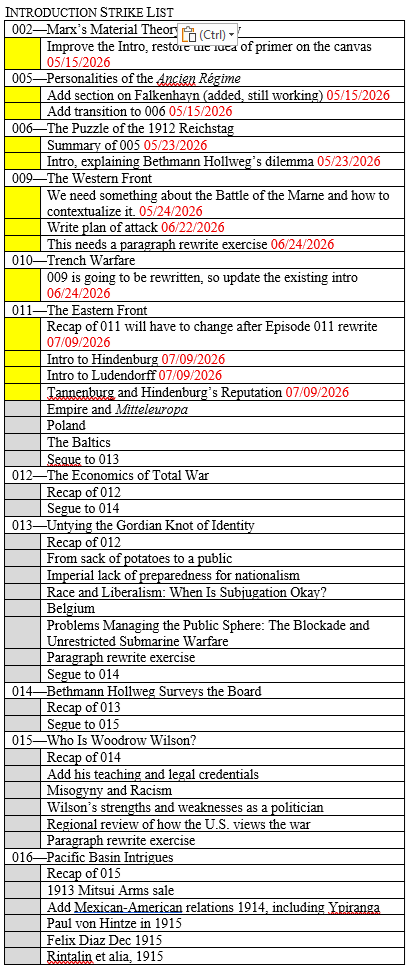
The obvious answer is race. So I’m moving submarine warfare to the section that I was dedicating to representation and identity in the war and making it one big Gordian knot that Bethmann Hollweg is trying to unravel. It will require compact writing. Wish me luck!